
22 May 2026
FLS timber the foundation for reconstruction of Iron Age crannog
Forestry and Land Scotland (FLS) grown timber is being used to bring back a taste of Iron Age life on Loch Tay in Perthshire.
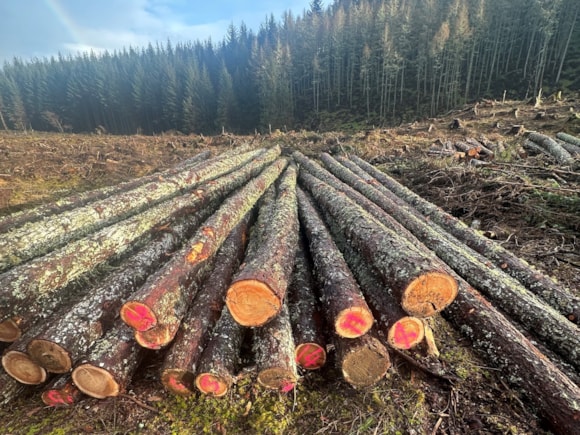
Around 150 tonnes of timber from FLS forests is providing the foundations for the reconstructed crannog – an Iron Age loch-dwelling – at the Scottish Crannog Centre in Dalerb.
Hundreds of larch trees ranging in size from between 10m and 2m were felled by hand to meet the specific requirements of the reconstruction. Larch provides exceptional water resistance, structural strength, and natural durability in damp environments.
FLS Niche Marketing and Hardwood Development Manager Douglas Halliday said:
“We were approached by the Scottish Crannog Centre with an extensive list of larch logs required to build the new Loch Tay crannog. The timber requirements were complex with a prioritised requirement for logs of different length and a range of diameters to meet design specifications for the structure.
“A call was put out across the regions for sites that could supply the required timber and a larch stand at Knapdale in Argyle and Bute along with trees in FLS forests at Craigvinean and Boreland in Perthshire were identified.
“With an order of this magnitude all to be felled by hand, there were a few challenges. Weather, wildlife and archaeological constraints had to be managed. It was also a chance for FLS’ craftsperson apprentices to get some hands-on experience harvesting timber for such a specialised project.”
The reconstructed crannog and the Scottish Crannog Centre as a whole aim to deliver benefits including jobs, apprenticeships, volunteering, alongside research and education opportunities with schools and universities.
The site for the centre at the Dalerb site was acquired through FLS’ Community Asset Transfer Scheme (CATS). The scheme enables communities to take greater control of the land through ownership or lease for projects that will benefit them.
Managing Director of the Scottish Crannog Centre Mike Benson said:
“The opening of the new crannog at the centre is in large part because of the unbelievable support from FLS. Firstly, through the CATS scheme and then bending over backwards and going more than the extra mile to supply much of the specialist timber needed in the reconstruction.
“Clearly the crannog is all about timber and this a genuine partnership in action making use of Scotland’s timber resources to bring history back to life with this incredible structure that is not just a building, but also part of our community.”
By the numbers:
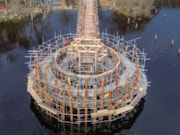
- The roundhouse (the part of the structure in which people lived) is approximately 8m high from floor to thatch;
- Timber posts were driven 1m into the loch bed the top of the roundhouse towers 14m above the loch bed at its deepest;
- The floor of the crannog is 6m above the average waterline (measured in April when the water is neither at its highest or lowest);
- The crannog has a diameter of 15m and is 48m in circumference including the walkway around the roundhouse (that’s around the size of a small circus tent and;
- The bridge is 50m long.
Contact Information
Neil Ratley
neil.ratley@forestryandland.gov.scot
Notes to editors
- All images free of charge for usage with this PR. Please credit Andrew Allan where indicated.
- Forestry and Land Scotland (FLS) manages forests and land owned by Scottish Ministers in a way that supports and enables economically sustainable forestry; conserves and enhances the environment; delivers benefits for people and nature; and supports Scottish Ministers in their stewardship of Scotland's national forests and land.
- Home - Forestry and Land Scotland
- Media enquiries to media@forestryandland.gov.scot
Downloads

Powered by Onclusive PR Manager © 2026